3rd February 2026
Watch Green Square partner Tony Walford share his perspective on The Shape of Agencies to Come for The Drum Predictions 2026.
As holding companies invest heavily in AI, streamline structures and cut headcount in the race for efficiency, the agency landscape is undergoing fundamental change. With legacy agency brands such as DDB and FCB set to disappear, what will 2026 mean for the future of agencies?
In this timely conversation, leading marketers explored what consolidation means for creativity, capability and culture – and how these shifts will affect brands seeking choice, diversity and innovation from their agency partners. The panel offer frank insights on survival, reinvention and what the next era of agencies may look like.
“I think I was slightly early when I said that 2025 would be the year of the indie,” says Tony Walford, a partner at finance and M&A advisory firm Green Square Associates. “But this year will certainly be the year of the indie.”
It’s not just that there’s sustained interest from buyers (especially those from the private equity space) in smaller, agile indie agencies. It’s that the industry’s macrodrama – Omnicom’s enormous acquisition of IPG; attempted international divestiture by Dentsu; continued difficulties for WPP – is providing space for growth in the industry’s nimbler corners.
“The big thing for me is the potential loss of creativity out the networks,” Walford said today at The Drum’s Predictions event in London. “The good people leave, they go and set up something else, and the networks are becoming a little bit homogenous.”
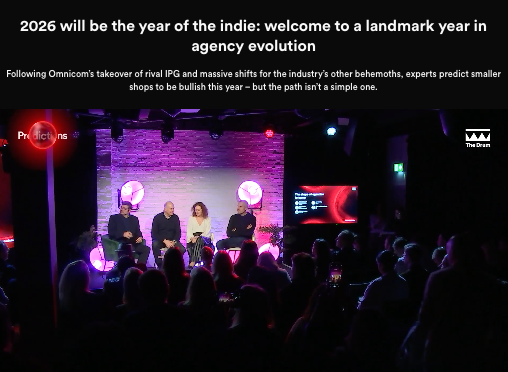
Walford was joined on stage by Jon Goulding, chief executive of indie shop Atomic; Justin Thomas-Copeland, CEO of US trade org the 4As; and Gabrielle Ludzker, the recently departed chief executive of Omnicom agency Rapp.
Ludzker knows the dynamics mentioned by Walford better than most, having spent the majority of her career at Omnicom agencies, most recently with that five-year stint at the helm of Rapp. As mergers and reshuffles have directly affected careers around hers, Ludzker sees these shifts as nothing short of a sea change.
“It just feels like this merger is almost the end of an era. You can see now that size and scale are of the utmost importance,” Ludzker says. “I think it’s tough for clients in that environment, because clients want to know who the talent is that they’re buying and they form relationships with humans and people and individuals that they value and they see them as really integrated in their businesses and core strategic partners. But you don’t know who you’re buying any more.”
A sea change is not a drop in the ocean; Ludzker expects Omnicom-IPG to be far from the last major agency consolidation. “This is a bit depressing,” she says, “But I think we’ll see the death of more amazing brands that we’ve known all our lives and that’ve done incredible work. That’s just not seen as valuable any more… What we’re seeing is that efficiency is now visible to the outside rather than under the surface – and as a result, more talent will leave.”
These dynamics inevitably lead to a certain amount of bullishness among smaller independent agencies. But their successes will be as hard-won as ever, says the 4As’ Justin Thomas-Copeland. “A lot of new independents have sprung up,” he says. “Many are doing well, but many are struggling and they’re not struggling because there isn’t a market. They have to find their feet. They have to make some tough choices.”
If the major networks have created space, in other words, other organisations will still have to innovate to fill that space. One trend Thomas-Copeland expects to expand in 2026 is indies filling that gap by coming together in looser networks and affiliations to provide an alternative operating model to incumbent networks, at a scale each wouldn’t be able to achieve on its own. “You see a lot of independents sort of coming together as collectives because they don’t have the money to invest and build it themselves. They’re being smart about how they come together. That seems to be working… I think those types of constructs will have their day in the sun.”
Jon Goulding, chief exec at indie shop Atomic, agrees that “the indie agency scene is buoyant,” but also says that success will not be automatic. “There’s never been a better time to be an indie, but at the same time, it’s really difficult. The economy is difficult. It’s hard to be self-funded.”